Plymouth and Exeter are considering delaying next May’s elections – but Devon County Council is not happy.
.
Hardly scintillating stuff in the run up to the festive fortnight, but the government has just announced the next steps for English council reorganisation – saying in a more detailed press release that councils have been offered flexibility to complete reorganisation, which basically means councils can postpone the May elections next year, as “come councils have told the department that elections could derail once-in-a-generation plans to scrap wasteful ‘two-tier’ councils”.
More problematically perhaps, it doesn’t give councils much time to respond, although today on the last day of the working year, the first counties confirm they will seek an election delay.

The whole process is proving not only disruptive but is causing a fair amount of uncertainty.
The Electoral Commission has hit out at potential delays to local elections, as it risks “damaging public confidence”. Vijay Rangarajan, the watchdog’s chief executive, said there was also “a clear conflict of interest in asking existing councils to decide how long it will be before they are answerable to voters”.
To take but one example of the wider impact of proposals for local government reorganisation, when it comes to the future of the built environment at local government level, the building industry, despite trying to be upbeat about “a bold new era for local government“, has today expressed “that dissolving smaller, more localised authorities and creating bigger councils that cover larger areas would have negative impacts on the ability to take important decisions about assets at a local level, the best way to optimise those assets and the way funding would be allocated”.
And another example in this week’s Sidmouth Herald reports how Devon’s children’s services have been praised for progress in a new report – but how the commissioner warned that breaking up the service through local government reorganisation could put this progress at risk.
Meanwhile the South West Devon MP is seeking clarity on council funds in the government’s reorganisation plans, as Rebecca Smith MP “calls for clear safeguards on council finances, with questions raised over how local funds would be treated under LGR plans”.
And today, Devon County Council has criticised the ‘misleading’ cash settlement from Westminster. As Torbay Today reports: With the provisional local government finance settlement announced yesterday (Thursday, December 18) – the amount of funding councils will get from the government for the year ahead – leading councillors have been quick to condemn the way it was presented. Councillor James Buczkowski, the council’s cabinet member responsible for finance, said: “For Devon, the year-on-year increase shown in core spending power is around 5% and that is driven largely by these council tax assumptions rather than by any significant uplift in core government grant”.
As for the suggestion from central government announced today, elections may be cancelled in Plymouth and Exeter – both Labour controlled. In response, the LibDem County Council leader has expressed anger over this ‘undemocratic’ power move, as reported in the Exmouth Journal, saying today: “Scrapping elections is incredibly dangerous, and the public will see this for what it is, a blatant and undemocratic attempt to retain power for longer. I will be appealing to Exeter and Plymouth’s council leaders to put democracy before party and press on with the vital process of allowing voters the right to decide who calls the shots. If they are serious about wanting councils to work efficiently and effectively, it is reorganisation they should postpone, not elections.”
The same piece provides a handy summary of where we are now: In July leaders of Devon County Council, Plymouth City Council, Torbay Council and district councils across Devon wrote jointly to Government to further ambitions for a comprehensive devolution agreement. This project, which would bring more power and funding to Devon through a Mayoral Strategic Authority, now appears in jeopardy, after mayoral elections were delayed in four other regions. Councils affected by the next tranche of reorganisation have until January 15 to request an election delay. A special meeting of Devon County Council will be held on January 9 to allow all members an opportunity to debate and respond
It’s even more complicated and confusing, however.
In September, Exeter City Council announced that Devon’s bid for a huge new unitary council won’t deliver for communities, preferring to bid for its own separate authority. And so in October, as per East Devon District Council, Devon councils announced a proposal for a new local government structure for the county, going back to dividing the county between two large north/east and south sections with Plymouth getting its own authority. [See map]
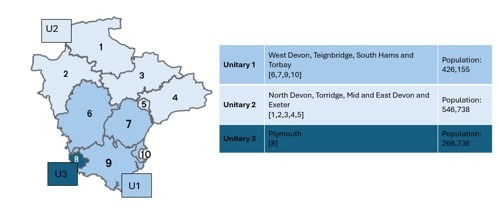
In response, in November, the cities of Exeter, Plymouth and Torbay teamed up to ensure their own place and proposed further new plans to carve Devon up into four unitary authorities. And and at the same time, Devon County Council published its blueprint for local government reorganisation – which was a reiteration of the proposal rejected back in September by Exeter.
This seems to be where we are now – with these various proposals sitting with central government who will make the final decision.
And to finish, here is how this blog has attempted to keep up with the comings and goings of proposals and counter-proposals over the last year: Shaking up local government in Devon: the ‘least worst’ option [October]; Reorganising Devon’s local government: an expanded Exeter or two new unitary councils? [August]; Have your say on the future of local government in Devon [July]; Shaking up local government in Devon: what should the name of any new local authority be? [February]; and Shaking up local government: fears about ‘rushed proposals’ [January]
….