… “for the people of Sidmouth interested in nature and for those from elsewhere interested in the nature of Sidmouth”
A look at a fabulous online resource for us all to enjoy and make use of
.
The Sidmouth Nature website is barely three years old in the making, but it has become a seriously-solid place to go for an understanding of how the natural world in the Sid Valley works and interplays. As its creator Philip Orchard says on the home page, this is “an information, learning and study resource”.
And quite a resource it is too.
FIRST STEP: THE NATURAL ENVIRONMENT
To take just the first subject in the home page and drop-down menu, clicking on the Natural Environment takes us in turn to several key topics, from Foundation Geology to Exploring Habitat. But before we dig into these, it is explained to us why we should be looking at these areas in our enthusiasm to understand Sidmouth’s nature. So, once we’ve considered the objectives of these pages, we are given a further didactic reminder – but ‘didactic’ in a friendly and helpful manner:
Before one can understand the natural history of an area it is necessary first to be aware of the natural environment in a wider context. This means understanding the effects of the local geology and how it can influence the kind of habitats that might occur. Then a knowledge of the characteristics of each habitat type is useful as well as how animals and plants find their niche in their preferred environment.
We therefore feel we are being guided through how best to approach the task of getting to know our natural environment better. Which then leads nicely onto the last section here, which is about Getting Started – and here with one of the many excellent pictograms on this website, we can see what we can do to ‘get started’:
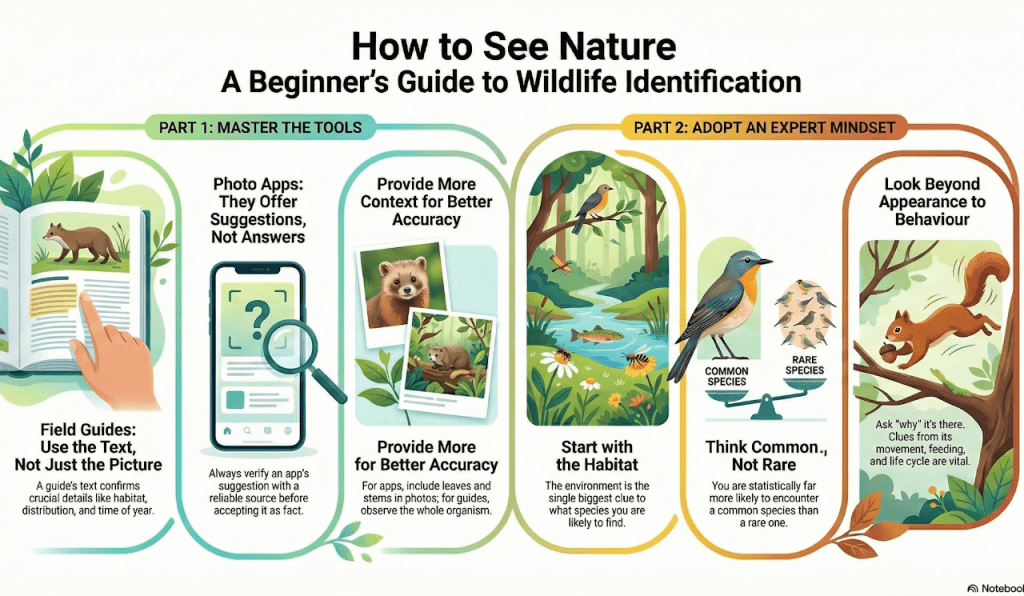
As the page suggests, such tools and approaches can really help us to not only learn things but to gain a little more confidence as we make our way through the Sid Valley – or through our back gardens:
This topic offers insights and guidance for anyone interested in learning more about the natural world. The threads aim to improve nature observation and identification skills and covers subjects from choosing and using identification aids to some laws of identification and finally suggests a learning project one might pursue to develop one’s skills.
Again, the website it not simply a list of stuff, which can be found anywhere online, but gives us specific guidance as to how to engage better with the natural world. In other words, it is educational in the best possible way.
So, as this page on ‘getting started’ unfolds, we are encouraged to ask some questions ourselves, which will prompt us to go out and find the answers ourselves, using the tools and skills we’ve been given and have (hopefully!) learnt.
And at the bottom of a thread of further links which will help us on our journey, we have a link to the subject of Citizen Science – where we look at how your personal discoveries can contribute to a global understanding of the natural world through Citizen Science.
All very useful – and inspiring!
TAKE A DIVE: EDUCATE YOURSELF
There is so much to discover in the pages of Sidmouth Nature – one very stimulating thread being the several Case Studies on offer which can take us into specific spots in Sidmouth and the Sid Valley to explore some of the themes and to see what we can find. And, again, we are given a gentle prod to help us on our way:
‘Sites of natural interest’ can provide a diverse array of benefits to the local ecosystem but, equally, they can face many challenges, especially those in built up areas. This thread pursues this thought and examines the strengths and weakness, threats and opportunities to sites in the Sidmouth area. These case studies demonstrate how sites almost anywhere are needed but under pressure.
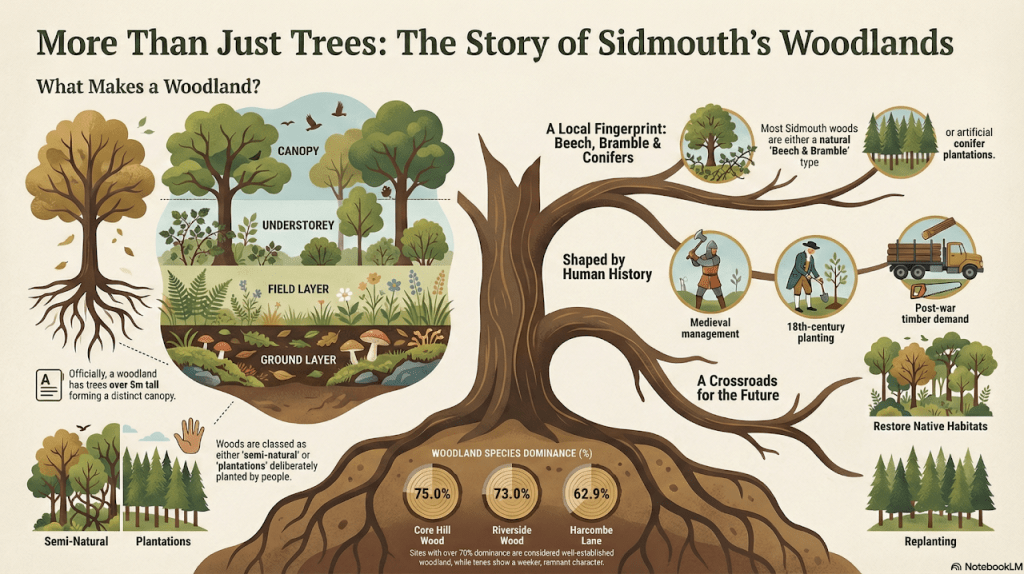
For example, the case studies about ‘trees and woodlands’ are more than that: in Telling Woods from the Trees, we learn there are twelve woodland sites around Sidmouth worthy of deeper consideration and so we are introduced to each in turn and encouraged to dive deeper, with further questions to stimulate and guide, and further weblinks to take us further into our learning and exploring.
The final thread takes us to Your Research – which is really about stepping into learning for oneself, but with that guidance we’ve been given throughout our exploration of this website. And it feels as though we really do have a teacher (that ‘didactic’ thing again!) to take us through these steps of going deeper into the nature of Sidmouth – as we go to the STUDIO to further your research …
To support the main purposes of the website the STUDIO enables the user to break free from the organised theme/topic/thread/text structure and ask questions that span more than one theme or use information that was used to create the website material but not specifically incorporated into the texts themselves. The STUDIO utilises a ‘shared’ source created within the Google app NotebookLM but requires no login or account details and is free to use. The STUDIO is simply an AI based question and answer facility.
Which takes us onto specific tools such as Observations Analysis and the Nature of Sidmouth – NotebookLM – but, as ever, what might feel a little scary in its demands is made open and friendly with its language and gentle (and gently didactic) approach.
And at the very bottom of each page we icon links which provide an instant connection to all sorts, from a Nature Diary to Sidmouth Nature – YouTube videos to observations on the “iNaturalist” widget page.
Finally, do have a look in the Resources page at the further page About the Sidmouth Nature project which tells us more about how the project website is provided to satisfy the needs of three possible types of visitors to the site, as well as how the creator’s background influences the Sidmouth Nature project and what level of confidence users should have in the accuracy of the information provided. A very honest self-appraisal!
This is a work in progress: new ideas and new pages are being added; new resources and tools are being developed; links are being updated. So, do keep returning to Sidmouth Nature for more.
Enjoy the learning! Enjoy the learning!
All with thanks to creator Peter Orchard for allowing the use of his material.
…